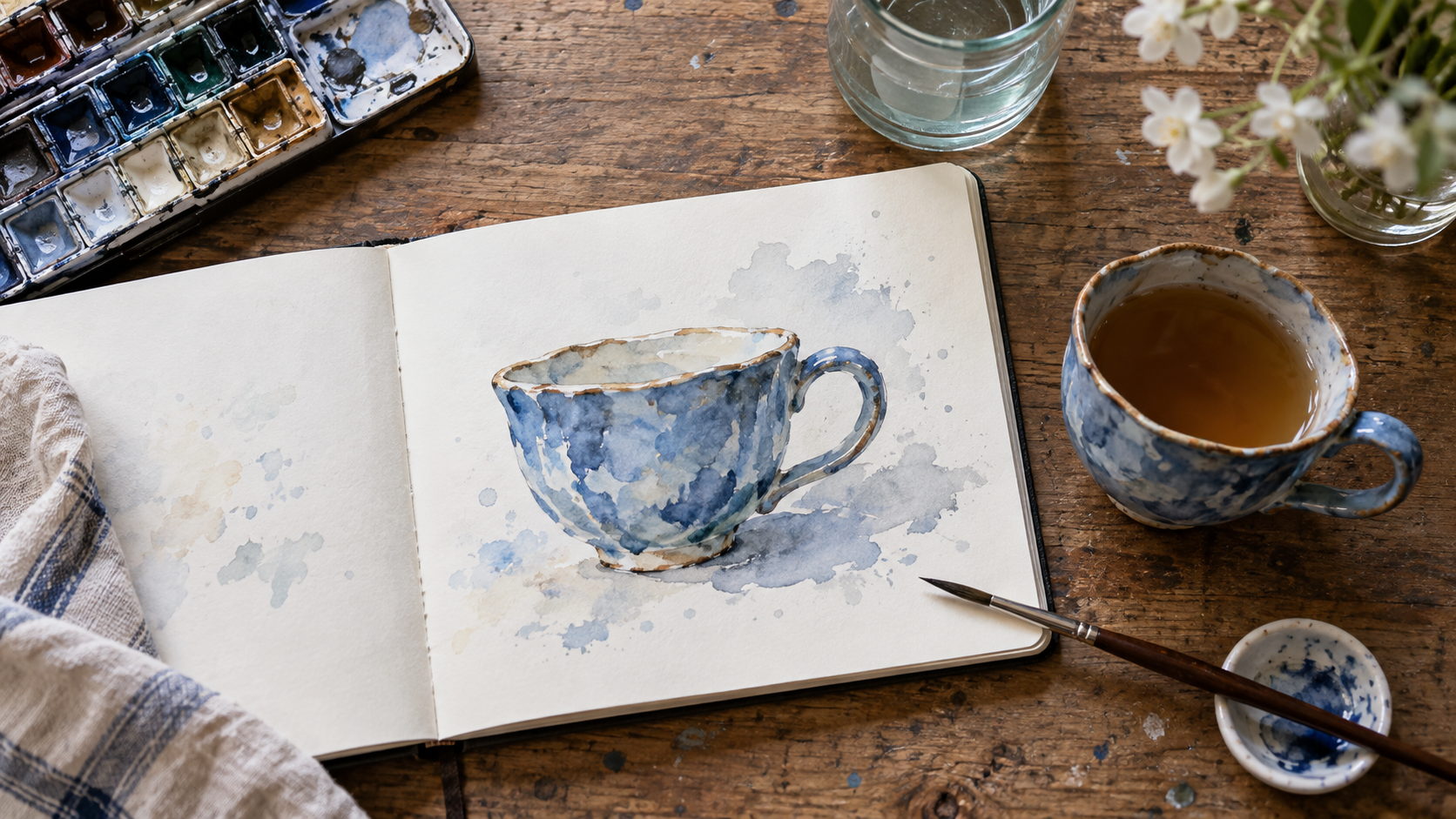
The cup in the drawing leans as though it has received disappointing news. Its handle is larger than the handle on the table. The rim is an ellipse with an independent political agenda. I considered tearing out the page.
Then I noticed that I liked the blue.
This should not have been a dramatic intervention. A sketchbook is a place to make sketches. Yet mine had acquired an imaginary visitor who apparently required every page to demonstrate a finished artistic identity. The visitor had never contributed paper, time or a single useful observation. I had nevertheless given them extensive editorial powers.
The wonky teacup stayed.
I am interested in learning to draw more accurately. That interest does not require every imperfect attempt to vanish. If I remove the evidence of what I am learning, the book becomes a carefully managed advertisement for progress rather than a record of it.
On the next page I drew the same cup again. I looked at the relation between the handle and the body, then at the angle of the rim. One feature became clearer. Another became worse. That was useful information, provided I allowed the page to exist long enough to compare it with the first one.
Choose a question smaller than be good
For a short session, I choose one thing to investigate. The curve of a handle. The darker patch where the cup meets the table. The way a reflected color interrupts a supposedly plain surface. A specific question gives the drawing somewhere to go even when the whole object refuses to become tidy.
The first cup's blue remained useful too. I mixed something similar and tested it on a scrap before returning to the page. I wrote a brief note about the mixture in language I would understand later. A pleasing color is an observation worth keeping even when it arrives inside an uncertain drawing.
This approach has made practice less like an examination. I do not finish every session with a verdict about whether I possess talent. I finish with a few marks, an observation and occasionally the decision to try again after making tea.
Let the book look handled
My sketchbooks live on the kitchen table, in a bag and sometimes beside a window where I forget them for an afternoon. The pages show evidence of that life. A water mark, a thumbprint, a small note squeezed into an inconvenient corner. I like the sense that a person used the object rather than prepared it exclusively for display.
There are paintings I want to finish carefully, and those can have different ambitions. The sketchbook does not need to audition for their job. It can hold a quick attempt, an unfinished thought and a page that makes sense only to the person who made it.
I have shown the wonky cup to friends. Some notice the leaning shape. Some notice the color. One asked whether the real cup was similarly unstable, which was a fair question and excellent motivation to observe the rim more carefully next time.
The page remains in the book, followed by several other cups with their own peculiarities. Together they show an afternoon of looking, a little irritation and a decision to continue.
Perfection can piss off for the duration of a sketch. I have a blue I want to try again.

A thought worth keeping?