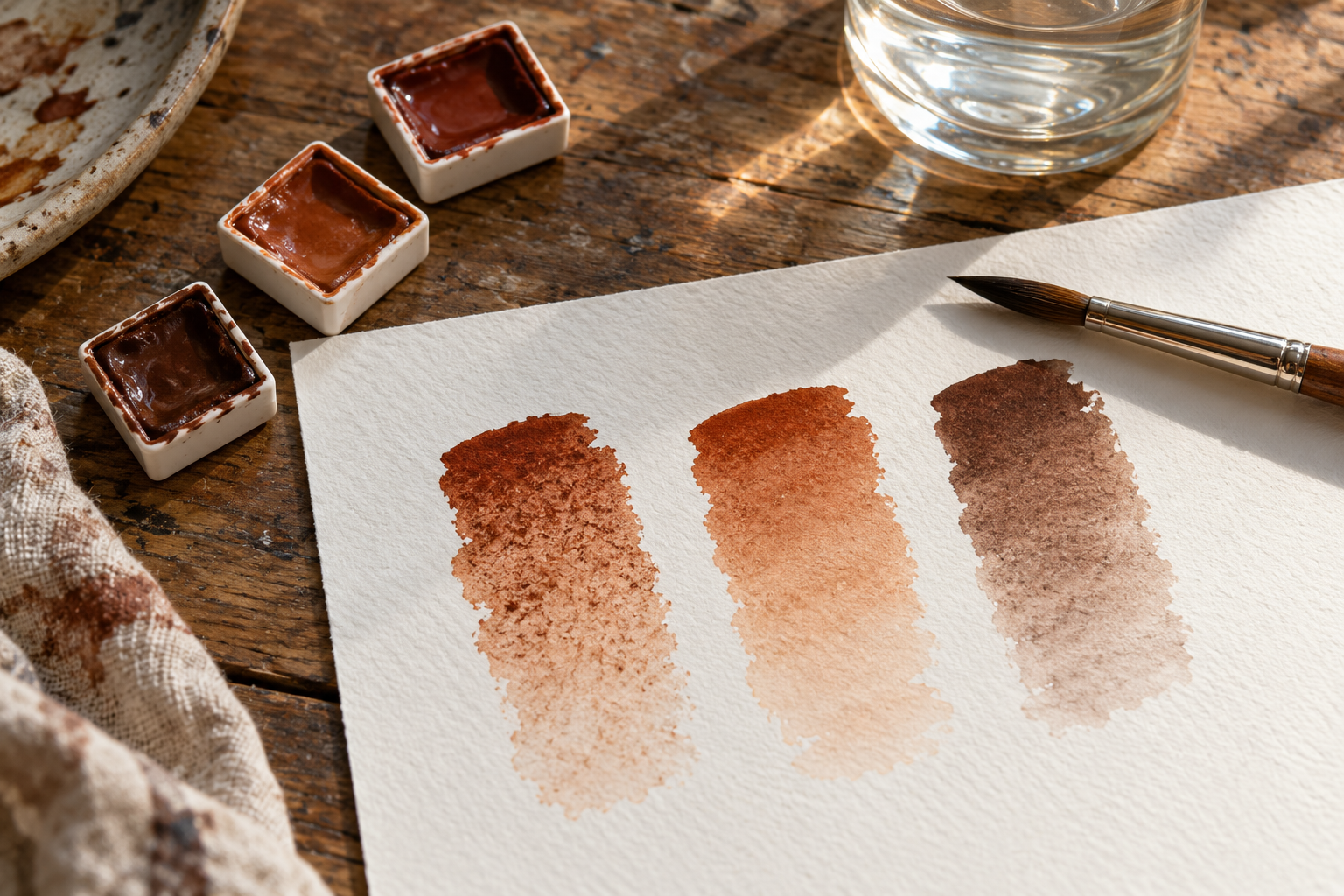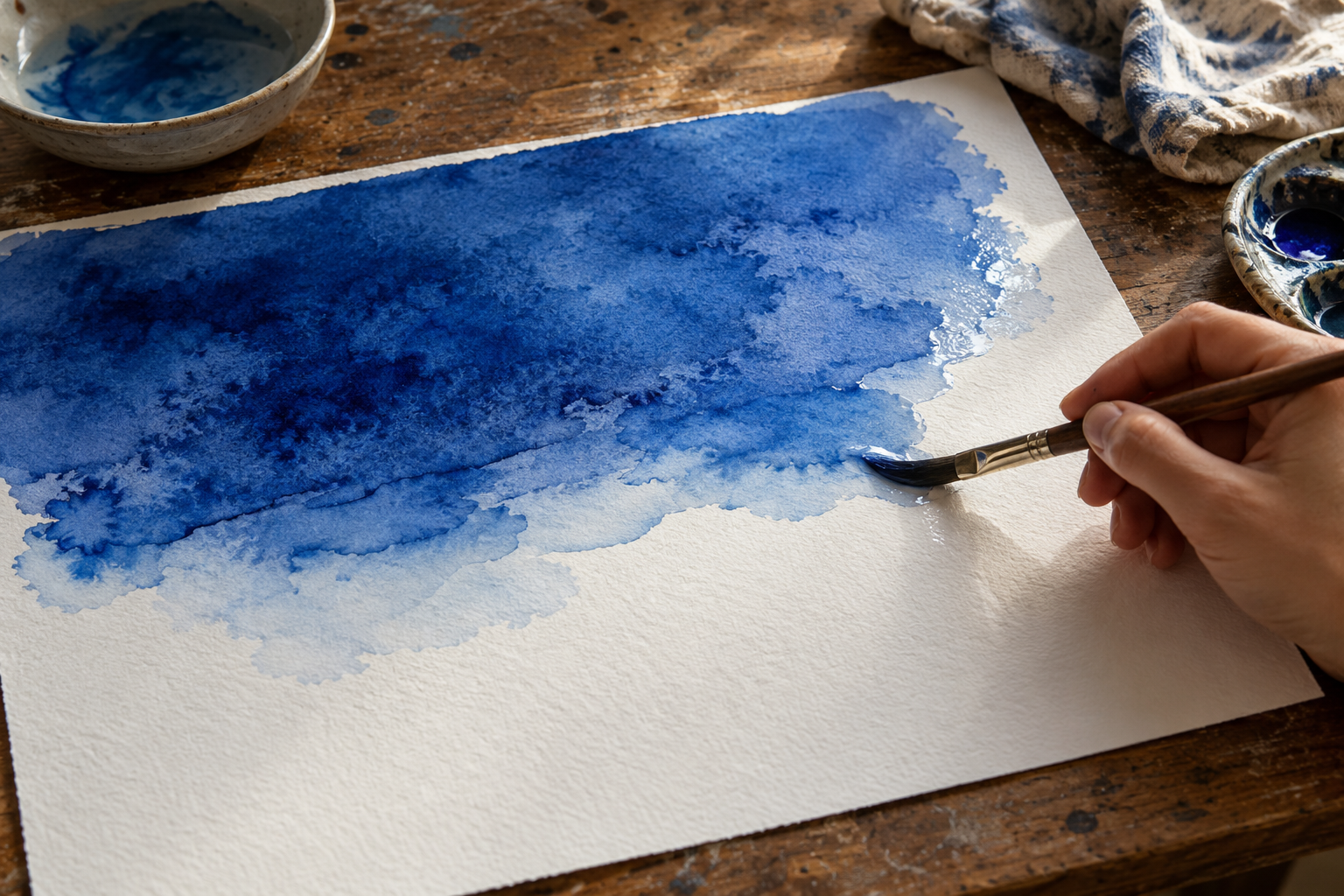
The first stroke of a watercolour wash puts a small clock in motion. Water spreads from the brush. Pigment moves with it, gathers at an edge, or settles where the surface holds it. The painter can tilt the sheet, feed more colour into the wet area, or leave the shine to fade. How much time those decisions have depends partly on something almost invisible in the paper: its sizing.
Sizing is a treatment that changes how readily a sheet takes in water. It does not turn paper into a waterproof tray. A useful watercolour sheet must accept a wash while giving the painter some control before the liquid disappears among the fibres. The balance is made during papermaking, then tested again each time a brush touches the page. A hard, slow-taking surface may let a bead travel farther than expected; a hungry one can seize the first stroke before the next can join it. Neither behaviour is a universal mark of quality. Each changes what a wash asks of the hand.
Where the delay comes from
Paper is a network of fibres and spaces. Liquid can enter that network, but it can also spread across its face. In an original paper-science study, researchers altered the weight, beating and wet pressing of laboratory sheets and measured their contact angles and water uptake. A smoother surface let drops spread more readily, while greater retention of an internal sizing agent, alkyl ketene dimer, raised the contact angle. These were laboratory handsheets, not finished artists' papers. The result is still a useful warning: a drop's visible spread and its penetration into the sheet are related but different events. Texture and fibre structure can change a wash alongside the sizing chemistry.
A maker can put sizing into the pulp before the sheet forms, apply it to a dried surface, or use both approaches. An account of papermaker Nick Pearson's watercolour paper formula names alkyl ketene dimer in the pulp and gelatin applied after sheet formation. Pearson wanted a firm sheet that would hold colour toward the surface, and he adjusted the fibre mix as well as the additives. His recipe is one maker's method, not a formula for every paper. It makes clear why a label such as “cotton paper” cannot by itself tell a painter how quickly a wash will settle.
The difference between sizing in the body and sizing at the face matters when water returns to a painted sheet. St Cuthberts Mill's technical description lists its Saunders Waterford paper as internally sized with a gelatin-sized surface. Arches describes its Aquarelle paper as gelatin sized through the sheet. These are makers' accounts of particular products, and their performance claims are not a controlled comparison. They show two ways a mill can distribute resistance to water. The name of an ingredient alone does not specify where it sits, how much is present or how the finished surface will feel under a brush.
What a wash reveals
Consider a broad, pale sky laid with a full brush. On a sheet that takes water quickly, the leading edge may lose its shine before the next stroke reaches it. The second stroke can then leave a seam instead of melting into the first. On a slower-taking sheet, the two strokes may join easily, yet the pool can run into a passage intended to stay pale. These are practical expectations from the different rates of uptake, not promises about any named brand. Paint concentration, brush load, tilt, room conditions and the paper's texture change the result as well.
There is no single number for “good absorbency.” In a 2022 study of six watercolour papers, researchers compared seven tests and found that several did not usefully evaluate the papers' absorption. They proposed reading Cobb water uptake, contact-angle change and dynamic permeability together. The published abstract gives neither a painter's preferred handling nor a ranking of all papers. Its important point is methodological: one quick droplet test cannot capture every part of the water–paper encounter. What looks like a simple wet or dry choice is a sequence of spreading, dwelling and entering.
Pigment complicates the story further. A wash is water carrying solid colour particles and a binder, not plain water. Once the liquid leaves, some pigment remains near the surface and some may lodge farther into its irregularities. Whether it can be lifted later therefore depends on the paint as well as the sheet. St Cuthberts Mill's lifting guidance says a wet, non-staining colour is usually easier to remove, and says its gelatin surface can hold pigment strongly enough to make dry lifting difficult. Arches, describing its differently sized paper, claims that wet or dry paint can be removed from its sheet. Those statements concern different products and are manufacturer guidance, not evidence that gelatin always prevents or always permits lifting. They are a reason to try a specific pigment on a specific sheet before promising a white highlight.
When the surface changes under the brush
Sizing is not an untouchable coating that behaves the same after every handling. The Saunders Waterford handling instructions warn that surface gelatin is most vulnerable while wet. They advise against detergent exposure because it can alter absorbency, and against touching the paint area with oily fingers. The mill's stretching notes also warn that excessively long soaking can reduce a surface gelatin layer. These cautions belong to its papers and processes; they do not mean a normally wet brush destroys the sheet. They explain why a patch that suddenly drinks paint can be a local change in the surface rather than a mysteriously different pigment.
The useful test is small and deliberate. On a spare corner of the actual sheet, place a clean water stroke and watch whether it beads, travels or loses its shine. Draw a modest coloured wash across it, then add a second stroke while the first remains glossy and again when it is only damp. After drying, try lifting a little of that particular pigment with clean water and a gentle brush. This is a studio comparison, not a laboratory measurement. It answers the practical question the label cannot: how long this combination of paper, paint and handling leaves the colour mobile.
Sizing sets a tempo for the wash rather than dictating its final shape. It can give the painter time to carry a colour across the sheet, hold pigment near the surface, and let one layer sit over another. Fibre, texture and the paint keep negotiating that tempo. The hand learns the paper by watching where the shine goes and what the colour leaves when it does.

A thought worth keeping?